
| Brake_Valve | PORTS_LIB.analog_signal | (n = 1) | IN | Position of brake valve (%) | |
| ST | PORTS_LIB.analog_signal | (n = 1) | OUT | Speed transmitter (Hz) | |
| T_brake | PORTS_LIB.analog_signal | (n = 1) | OUT | Output temperature of the brake (C) | |
| Valve_in | PORTS_LIB.analog_signal | (n = 1) | IN | Position of Inlet valve (%) | |
| f_in | fluid | IN | |||
| f_out | fluid | OUT |
| D | REAL | 0.055 | Blade diameter | m | |
| Ed_brake | REAL | 800 | Design power dissipated in the brake | W | |
| M | REAL | 3 | Shaft mass | kg | |
| N_d | REAL | 2620 | Design speed | rps | |
| No | REAL | 2620 | Inital value of the shaft speed | rps | |
| P_in_d | REAL | 1 | Design inlet pressure | bar | |
| P_out_d | REAL | 1 | Design outlet pressure | bar | |
| Pin_brake | REAL | 1 | Inlet brake pressure | bar | |
| Po | REAL | 1 | Initial pressure | bar | |
| Rv | REAL | 50 | Flow range of valve at constant drop | - | |
| T_in_d | REAL | 300 | Design inlet temperature | K | |
| Tin_brake | REAL | 300 | Inlet brake temperature | K | |
| To | REAL | 300 | Initial temperature | K | |
| dPd_brake | REAL | 1 | Brake pressure gain | bar | |
| eff_is_d | REAL | 0.73 | Design isentropic efficiency | - | |
| m_d | REAL | 0.111 | Design mass flow | kg/s | |
| mat | ENUM THERMAL.Material | SS_304 | Wall material | ||
| md_brake | REAL | 0.04 | Design mass flow in brake | kg/s | |
| thw | REAL | 0.01 | Wall thickness | m | |
| valved_brake | REAL | 30 | Brake valve opening percentage at design conditions | % |
| Aout | REAL | Area at the outlet | m^2 | ||
| E | REAL | Energy provided by the fluid | W | ||
| E_brake | REAL | Power dissipated in the brake | W | ||
| E_d | REAL | Design energy provided by the fluid | W | ||
| G | REAL | Mass flow per unit area for molecular flow | kg/(s�m^2) | ||
| Gd | REAL | Design mass flow per unit area for molecular flow | kg/(s�m^2) | ||
| I | REAL | Moment of inertia of the rotor | kg�m^2 | ||
| N | REAL | Shaft speed | Hz | ||
| Pout_brake | REAL | Outlet brake pressure | bar | ||
| Poutd_brake | REAL | outlet designed brake pressure | bar | ||
| cj | REAL | Jet velocity | m/s | ||
| cj_d | REAL | Design jet velocity | m/s | ||
| dP | REAL | ||||
| dP_lam | REAL | Pressure difference for laminar flow | bar | ||
| dP_loss | REAL | Pressure loss | Pa | ||
| eff_is | REAL | Isentropic efficiency | - | ||
| h_brake | REAL | Enthalpy of the brake | J/kg | ||
| h_in | REAL | Inlet enthalpy | J/kg | ||
| h_in_d | REAL | Design inlet enthalpy | J/kg | ||
| h_out | REAL | Outlet enthalpy | J/kg | ||
| h_out_s | REAL | Outlet enthalpy in a isentropic process | J/kg | ||
| h_out_s_d | REAL | Design outlet enthalpy in an isentropic process | J/kg | ||
| hin_brake | REAL | Enthalpy at the inlet of the brake | J/kg | ||
| ier | INTEGER | ||||
| m | REAL | Mass flow | kg/s | ||
| m_brake | REAL | mass flow in brake | kg/s | ||
| rho | REAL | Inlet density | kg/m^3 | ||
| rho_in_d | REAL | Design inlet density | kg/m^3 | ||
| s_in | REAL | Inlet entropy | J/kg | ||
| s_in_d | REAL | Design inlet entropy | J/kg | ||
| u1 | REAL | Blade velocity | m/s | ||
| u1_d | REAL | Design blade velocity | m/s | ||
| v | REAL | Blade-jet speed ratio | - | ||
| v_d | REAL | Design blade-jet speed ratio | - | ||
| vsound_d | REAL |
This section gives a description of the model developed for simulating turbines at off-design conditions.
There are different ways of calculating the mass flow through a turbine. The mass flow has been calculated from the value of the design mass flow multiplied by the ratio between the isentropic mass flow per unit of area at working conditions and the isentropic mass flow per unit of area at design conditions.

where  is the mass flow at working conditions,
  is the mass flow at the design condition,
 and
and 
are the isentropic mass flow per unit of area at working conditions and at design conditions respectively.
G is calculated as in a junction:

The approach that has been used for calculating mass flow per unit of area through the turbine is to regard the stator blade section as an orifice.
The isentropic efficiency for a turbine is given by the equation:

where  �is the outlet enthalpy for an
isentropic expansion, ho is the inlet enthalpy and h2 is the outlet enthalpy.
�is the outlet enthalpy for an
isentropic expansion, ho is the inlet enthalpy and h2 is the outlet enthalpy.
The isentropic efficiency of a turbine can be calculated by means of dimensionless parameters. The dimensionless parameter often used to calculate the radial-inflow turbine performance is the blade-jet speed ratio:

where  �is the jet velocity and u1 is
the blade velocity.
�is the jet velocity and u1 is
the blade velocity.
The jet velocity is defined as the velocity corresponding to the ideal expansion through the turbine:

The blade velocity is given by the next equation:

where D is the rotor blade diameter and N is the shaft speed.
The variation of the efficiency for a
turbine can be approximated by a parabolic curve. The ratios  �and
�and  �are used as parameters for
this parabolic equation,where hopt is the optimum efficiency and nopt is the corresponding optimum blade-jet speed ratio. It is
assumed that the turbines are designed to run at the optimum point. This means
that
�are used as parameters for
this parabolic equation,where hopt is the optimum efficiency and nopt is the corresponding optimum blade-jet speed ratio. It is
assumed that the turbines are designed to run at the optimum point. This means
that  �and
�and  �where the subscript d denotes
the values used as design values. Thus, the parabolic equation to calculate the
isentropic efficiency is the following:
�where the subscript d denotes
the values used as design values. Thus, the parabolic equation to calculate the
isentropic efficiency is the following:
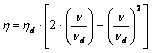
The rate of energy required to accelerate the speed of the shaft is a function of the rotational inertia of the impeller and the rotational speed:

where  is the rotational inertia
If the inertial component is not considered, then the forth power of the speed is proportional to the energy flux provided by the fluid:

The equation to calculate the speed in off-design mode without the inertial component is as follows:
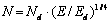
where  is the energy flux provided by the fluid and
  �is the design energy flux
provided by the fluid.
�is the design energy flux
provided by the fluid.


where is the mass flow and the subscript d denotes the design values.
If the inertial component is considered, the equation used to calculate the speed will be the following:
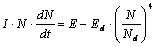
The initial value of the dynamic variable  �is obtained from the
initialization data
�is obtained from the
initialization data  :
:

Document generated automatically with EcosimPro Version: 5.4.14 Date: 2015:02:02 Time: 12:52:59