Stream formulation:
Calculation of this component uses enthalpy
and pressure as state variables. The derivatives of these variables appear in
the balances of mass and energy.
Mass balance
The following equation represents the mass
balance to node i:
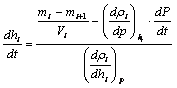
where:
 �is the volume of the node i,
that is to say, the total stream volume divided by the total number of nodes
�is the volume of the node i,
that is to say, the total stream volume divided by the total number of nodes
 �and
�and  �are the inlet and outlet mass
flow respectively of node i
�are the inlet and outlet mass
flow respectively of node i
 is the density inside node i
 is the derivative of the density with respect to the pressure at
constant enthalpy
is the derivative of the density with respect to the pressure at
constant enthalpy
 is the derivative of the density with respect to the enthalpy at
constant pressure
is the derivative of the density with respect to the enthalpy at
constant pressure
The pressure in all the nodes of the stream
is considered to be the same so as to simplify the mathematical calculations.
Energy balance
Shown below is the energy balance to one of
the nodes into which� the stream is
divided:

where:
 �and
�and  are the inlet and outlet specific enthalpy to node i respectively.
And
are the inlet and outlet specific enthalpy to node i respectively.
And  �is the specific enthalpy
inside the node i.
�is the specific enthalpy
inside the node i.
 is the heat flux transferred in node i
 �is the ratio between the wall
heat capacity and the fluid heat capacity in node i. It is calculated by means
of the following expression:
�is the ratio between the wall
heat capacity and the fluid heat capacity in node i. It is calculated by means
of the following expression:
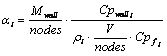
where:
�����������  �is the total metal mass
associated with the stream
�is the total metal mass
associated with the stream
�����������  �and
�and  are the metal heat capacity and the fluid heat capacity respectively
in node i
are the metal heat capacity and the fluid heat capacity respectively
in node i
�����������  is the fluid volume
����������� is the fluid density in node i
State equation
The physical properties of the fluid in the
nodes use the pressure and the specific enthalpy as independent variables.
|
Property
|
Calculation
|
|
Temperature
|

|
|
Density
|

|
|
Thermal conductivity
|

|
|
Viscosity
|

|
|
Prandtl number
|

|
|
Derivative of the density with respect to
the pressure at constant enthalpy
|

|
|
Derivative of the density with respect to the
enthalpy at constant pressure
|

|
Mass flow calculation
The calculation of the mass flow at the
inlet or at the outlet depends on which flow characterization has been
selected. This mass flow is calculated from the expression of the pressure loss
along the channel as a function of the design values. This expression is the
following:

The pressure loss is equal to the
difference between the inlet and the outlet pressure:

where:
�����������  �and
�and  �are the inlet pressure and
the outlet pressure
�are the inlet pressure and
the outlet pressure
�����������  is the pressure loss of the stream along the channel
�����������  is the design pressure loss of the stream along the channel
�����������  and
and  are the working mass flow and the design mass flow respectively
����������� and are the working density in the node i and the design density
respectively
are the working density in the node i and the design density
respectively
�����������  and
and  are the working viscosity in the node i and the design viscosity
respectively
are the working viscosity in the node i and the design viscosity
respectively
�����������  �is the total number of nodes
in which the stream is divided
�is the total number of nodes
in which the stream is divided
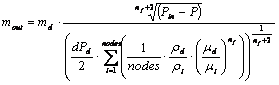
If the option Resistive_Storage has been
selected, the inlet mass flow will be calculated from the pressure loss
equation:
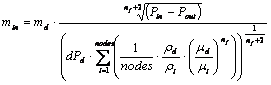
where:
����������� �and �are the pressures at the
inlet and at the outlet of the stream
����������� �is the design pressure loss
of� the stream along all the length of
the channel
And the outlet pressure equals the pressure
in the nodes.

If the option Storage_Resistive has been
selected then the outlet mass flow is going to be calculated from the pressure
loss equation:
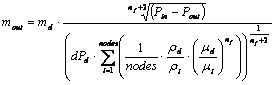
In this case the inlet pressure equals the
pressure in the nodes:
����������������������� 
However, if the option chosen is
Resistive_Resistive, then the inlet and the outlet mass flow will be calculated
from the pressure loss equation:
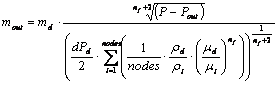
And the inlet and outlet pressure will be
boundary conditions.
Global heat transfer coefficient
The global heat transfer coefficient in each
node is calculated using the design data as follows (Colburn, see R):
����������� 
where:
 �is the global heat transfer
multiplied by the transfer area in node i
�is the global heat transfer
multiplied by the transfer area in node i
 is the global heat transfer multiplied by the transfer area at the
design conditions for all the heat exchanger
is the global heat transfer multiplied by the transfer area at the
design conditions for all the heat exchanger
 �and
�and  are the thermal conductivity in node i and at the design conditions
respectively
are the thermal conductivity in node i and at the design conditions
respectively
 and
and  are the Prandtl numbers in node i and at the design conditions
respectively
are the Prandtl numbers in node i and at the design conditions
respectively
and are the viscosity in node i and at the design conditions
respectively
 �is a constant exponent that
appears in the Colburn equation
�is a constant exponent that
appears in the Colburn equation
Port equations
The equations for the port variables depend
on the direction of the stream flow: countercurrent or parallel.
If the direction of the stream flow is countercurrent,
then the port variables are calculated as follows:



The temperatures in the thermal nodes:


The temperature in the internal thermal
nodes, from i = 2 to i = nodes:

If the direction of the stream flow is parallel,
then the port variables are calculated as follows:


The temperatures in the thermal nodes


The temperature in the internal thermal
nodes, from i = 2 to i = nodes

Initialization
The initial values of the dynamic variables
are obtained from the initialization variables with:


The temperature of the nodes can be
initialized depending on the value of the construction parameter init_mode as
follows:
 init_mode = Constant_T. All the
nodes are initialized at the same temperature To.
init_mode = Constant_T. All the
nodes are initialized at the same temperature To.
init_mode = Linear_T. Nodes are
initialized following a linear progression. The user defines an initial value
To for the first node and an initial value Tn for the last node. The
temperature is calculated as a linear function of these temperatures.

init_mode = Table_T. The
temperature of the nodes is defined by the user in a table. The temperature of
each node is read from this table.
 The outlet temperature of the
fluid in a node is equal to the fluid temperature inside the node.
The outlet temperature of the
fluid in a node is equal to the fluid temperature inside the node.